






Home : Solar Low Energy X-ray Spectrometer (SoLEXS) on board Aditya-L1 Mission
Last updated on: 22-Jun-2026
Solar Low Energy X-ray Spectrometer (SoLEXS) on board Aditya-L1 Mission
|
Overview: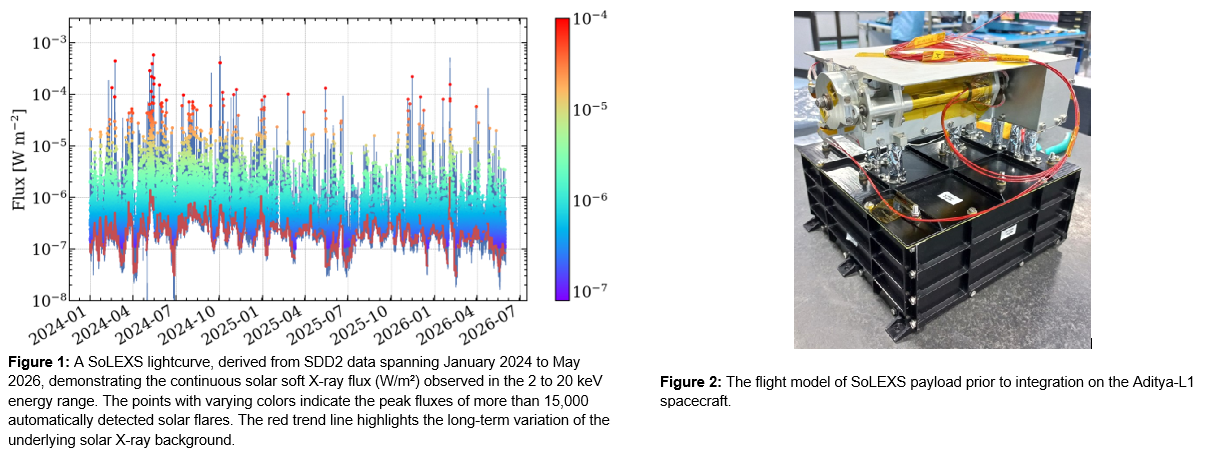 Solar Low Energy X-ray Spectrometer (SoLEXS) is a scientific payload on board Aditya-L1, India’s first dedicated space-based solar observatory operating at Lagrangian point 1 (L1). A key focus of this mission is understanding solar flares, which are sudden, highly intense bursts of radiation resulting from the rapid release of magnetic energy in the solar atmosphere. Continuous monitoring of soft X-ray emissions is essential for studying these events, as they provide direct, real-time measurements of flare activity and coronal plasma heating. Figure 1 illustrates this capability, showcasing a SoLEXS lightcurve spanning January 2024 to May 2026 that captures more than 15,000 automatically detected flares. SoLEXS was specifically designed to serve as this continuous monitor for dynamic low-energy X-ray emissions. The instrument was developed by the Space Astronomy Group (SAG) in collaboration with different entities across URSC.
Scientific Objectives:The primary science objectives of the SoLEXS payload are to:● Understand solar flares and the underlying mechanisms of coronal heating. ● Quantitatively measure coronal abundances and investigate the First Ionization Potential (FIP) effect. ● Study the association of flares and Coronal Mass Ejections (CMEs) using CME data from Aditya-L1 and/or other operating observatories. ● Conduct flare and prominence eruption studies using prominence data from Aditya-L1 and/or other observatories operating during this period.
Payload Configuration: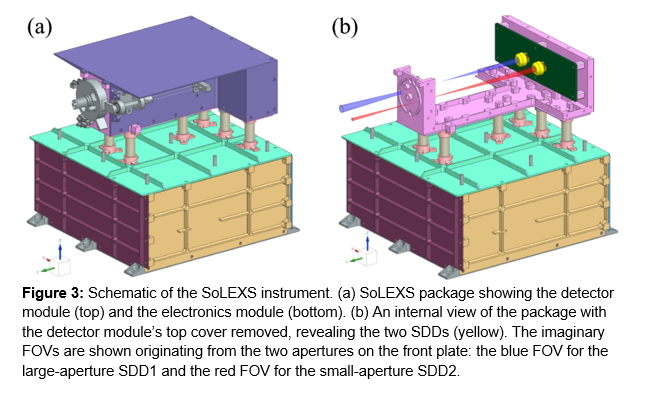 SoLEXS utilizes solid-state Silicon Drift Detectors (SDDs), a state-of-the-art detector technology, to capture soft X-ray spectra. The instrument employs a dual-SDD configuration consisting of two sensors, SDD1 and SDD2 (Figure 3), operating at a cooled temperature range of -60°C and -40°C. These sensors have different aperture areas of approximately 7.1 mm² and 0.1 mm² respectively. This two aperture configuration is designed to handle the vast dynamic range of solar X-ray intensities, from powerful X-class events (using SDD2) to faint A-class microflares (using SDD1).
Key Features and Capabilities:● Broadband Energy Range and Resolution: SoLEXS operates across an energy range of 2 to 22 keV. The SDDs provide continuous spectral coverage for the analysis of thermal solar emissions, achieving a moderate energy resolution of ≈170 eV at 5.9 keV.● Wide Dynamic Range: The dual-detector configuration, utilizing two aperture sizes for small-scale and large flares, enables the instrument to cover a vast intensity spectrum without detector saturation. This design seamlessly observes flares from A-class to X-class. ● High Temporal Resolution: SoLEXS is capable of recording solar X-ray data with a highly rapid cadence, capturing spectral data every 1 second and broad temporal channel data every 0.1 seconds. This is essential for tracking the fast evolution of solar flares. ● Indigenously Engineered Pulse Processing: SoLEXS integrates an in-house Charge Sensitive Preamplifier (CSPA) directly with the SDD. Custom-built Digital Pulse Processor (DPP) algorithms run on an FPGA, delivering superior stability, enhanced high-rate performance, and dedicated pile-up rejection logic to ensure precise spectral measurements during extreme solar flares.
References● Sankarasubramanian, K., et al. (2025). Solar Low Energy X-ray Spectrometer (SoLEXS) on Board Aditya-L1 Mission. Solar Physics. DOI: 10.1007/s11207-025-02494-0● Bug, M., et al. (2026). Solar Low-Energy X-ray Spectrometer onboard Aditya-L1 mission: design and qualification. Journal of Astronomical Telescopes, Instruments, and Systems (JATIS). DOI: 10.1117/1.JATIS.12.2.026002 ● Sarwade, A. R., et al. (2025). Solar Low Energy X-ray Spectrometer on board Aditya-L1: ground calibration and in-flight performance. Journal of Astronomical Telescopes, Instruments, and Systems (JATIS). DOI: 10.1117/1.JATIS.11.4.045005 |